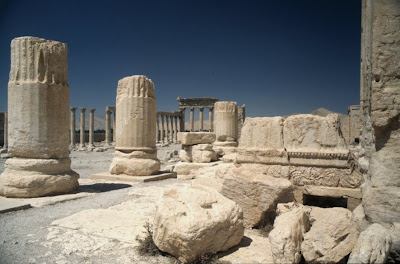
29.5.12
Ruins of Iskandar
18.5.12
Ruins of Datong
7.5.12
Ruins of Heliopolis
28.4.12
Ruins of Hiroshima
8.3.12
Ruins of Ephesus

This tiny fragment of marble (8cm) has a story to tell.
Our story takes place in
The façade of the ancient library still greets visitors today. As do the remains of the public baths across the street, featuring an outer courtyard latrine surrounded by marble benches, under which water ran to flush away the waste. Musicians are said to have performed on a platform under a colonnade in the centre of the courtyard to entertain the people as they went about their business, (so to speak).
You guessed it. This fragment was once part of that very toilet seat.
Also to be seen in
This is clearly the official doctrine of the Catholic Church. Why else would the current Pope say, on his very first foreign trip, undertaken to Turkey, on November 29, 2008:
"From here in Ephesus, a city blessed by the presence of Mary Most Holy, who we know is loved and venerated also by Muslims, let us lift up to the Lord a special prayer for peace between peoples."
It is my contention that this fragment may well be a priceless holy relic.
After all, what can the Virgin have done with her time between the Ascension and her own Assumption? I suspect she must have availed herself of the wondrous library. And when nature called, she must have slipped across to the public toilet, where this fragment of marble, attached as it was to the rest of the seat at the time, almost certainly must have come into contact with the immaculate backside.
Ephesus dwindled and was eventually abandoned in the 15th century as its port silted up and its trade access failed.
5.3.12
Certain Female Spiders
Chivalry is dead, but that tradition of gallantry formerly masked and to some degree mitigated the organized oppression of women and its echoes still resonate. While males monopolized political and economic power, they made their domination of women more palatable by surrounding it with an elaborate ritual of deference and postures, letting them pass through doorways and get into lifeboats first.
They set themselves up as the protectors of the weaker sex, and this cloying but useful fiction set some limits to their capacity to exploit women through sheer physical force. Although, at the same time, the counter-convention of droit de seigneur, which justified the predatory exploits of privileged males against women socially inferior to themselves, showed that at no time did men cease to regard most women as fair game.
The exploitation of women by men, far from constituting a secondary formation dependant in one way or another on the organization of production, as good Marxists are taught to think, antedates the establishment of production based on private property. Needless to say, no slur clings to Odysseus for his infidelities to Penelope, willing or unwilling, in the course of his wanderings homeward. The faithfulness required of a man to his home and his kin did not include the chastity of his body as it did in the case of his wife. The long history of rape and seduction serves as a reminder that animal strength and nothing to do with the economic system, remain the basis of masculine ascendancy, manifested in its most direct, ancient and brutal form.
Yet polite conventions, even when they are no more than a facade, function as an operational myth that provide women with a degree of ideological leverage in their struggle to domesticate the wildness and savagery of men. We have surrounded essentially exploitative relationships with a network of reciprocal obligations, which if nothing else, obscures the exploitation, thereby making it perhaps a little easier to bear. Nevertheless, regardless of her poise and her intellectual maturity, the fact remains that Simone was still deeply hurt by Jean-Paul’s infidelities.
Male and female are subjective assignments. A society which grants the privilege of doing or being done to, exclusively to one sex or the other, warps its children. A child of either sex has urges to penetrate, devour, and possess; to be cherished, dominated, and contained. Who can resist a detailed account of how certain female spiders eat their mates?
2.3.12
Ruins of Tikal
29.2.12
Tracking the Changes
The pace of change began to pick up after the soldiers in Little Rock, after Elvis appeared in black and white from the waist up on the Ed Sullivan Show, (white-bread America missing the point that the point was those thrusting hips), and those changes continued and accelerated and gathered momentum as part of the rights of cultural passage from Eisenhower through the sacrificial Kennedy to Nixon, when Ken Kesey and the Merry Pranksters displaced Dale Carnegie as the arbiters of the ethos.
We all thought the Great Proletarian Cultural Revolution actually had something to do with culture, and we were vaguely in favor of that. We downed quantities of peyote and mescaline and LSD and wrestled with insight while watching the dark clouds of enlightenment hanging over angry orange sunrises through bloodshot eyes. There were black and red posters of Che in his beret, and one that said Electric Circus in day-glo letters that shone in the dark.
Beatles, Doors, topless, bottomless,
Were there any of us of that generation who were not skewed and exhilarated and disillusioned by the simple awareness of ourselves against the backdrop of 1968? Doctor King’s dream moved us deeply, and we felt an enthusiastic agreement when Maharishi Mahesh Yogi said, with one of those distinctively Indian waggles of his head, “If we are blessed with the ability to have desires, why should we not also have the right to try and realize them?”
But the very pretence of revolutionary solidarity itself vanished, as the
The beliefs that we might have clung to had been cancelled by the advances of science. We were metaphysical vagabonds, lost souls in a state of confusion. God was well and truly dead. What passed for spirituality was simply an outpouring of words and style; a mixture of pop psychology, recycled hippie philosophy, scraps of Hindu claptrap,* cultural-specific nonsense and Judeo-Christian contradictions.
*Jagganath means lord of the universe. It is one of the names of